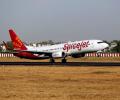
Crisis-hit SpiceJet plans to hand out pink slips to at least 1,000 employees in the coming days as the airline works to significantly reduce costs and streamline operations of its depleted aircraft fleet, officials said on Monday. Faced with financial woes, legal battles and other headwinds, the no-frills carrier might ask more staff to leave as there is excess manpower now compared to the number of planes in service. A final decision on the quantum of layoffs is expected this week, one of the officials in the know said.

The Indian aviation sector is on the cusp of a change as airlines look to induct a record number of aircraft. This, analysts said, will put the sector on a growth runway, though keeping it viable for only long-term investors. According to Vinit Bolinjkar, head of research at Ventura Securities, expectations of strong air traffic, coupled with low penetration, is the prime reason for a solid long-term outlook.

The DGCA advised airlines to remain ready to operate additional flights from the Srinagar airport if the need arises.

IndiGo has about 400 planes on order.

Air India, SpiceJet, IndiGo and AirAsia India ready to fill in the gap.
Airlines operated at much lower capacity of about 27% this July compared to July 2019 level, but there was a marginal rise over the 25% capacity achieved in June 2020.

Government to ask airlines to educate flyers. 'It will be an exhaustive charter which will tell the passenger about all their rights, like whether they are eligible for a refund when there is a delay in flight, what to do in case of a flight delay and other in-flight etiquette.'
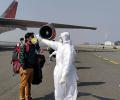
'The recent price hike would only be beneficial if the airlines continue to operate at 80 per cent airline capacity. An increase towards 90 or 100 per cent airline capacity would again add pressure to the fares as demand remains muted. Also, we are in the fourth quarter of the fiscal year which is a seasonally weaker quarter,' says an analyst.

Air fares up 20-30 per cent as operating costs mount.
While Jet Airways continues to fly high with a dominating presence among airlines in India, it also leads in the number of passenger complaints.

Rising fuel prices, intense competition and inability to pass on spiralling expenses have been negatively impacting the domestic airlines.

Strong passenger growth will help domestic airlines improve their top line and margins.

After Air India and IndiGo, SpiceJet is the third carrier to cancel the ticket of the Lok Sabha member.
SpiceJet's resurgence, once the new funding is in place, has the potential to disrupt the Indian aviation market in 2024 as the airline will bring its grounded aircraft back to service and lease as many planes as possible to be competitively relevant, aviation consultancy firm Capa India said on Thursday. "Although the market for procuring aircraft in 2024 is exceptionally tight, we expect that SpiceJet will bring stored aircraft back into operations, and will wet or dry lease as much capacity as possible, in order to be competitively relevant. "This will have a material impact on the industry structure, and possibly on domestic profitability," Capa India said in its report.
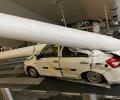
The Delhi airport, the country's busiest airport, on Friday early morning witnessed the collapse of a roof at Terminal 1 amid heavy rains that killed one person, prompting the government to order a detailed probe and an inspection of the structural strength of all airports.

Virtually addressing employees of Air India across the globe, he said for the airline to be the best again there will be an organisational redesign, and it will "require a huge transformation, probably the largest transformation and the change all of you would ever go through". The carrier will expand its "outreach both domestically and internationally" and it has the desire to connect India with every part of the globe, he added.

Indigo remains the leader with market share of 27.8 per cent.
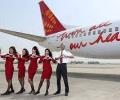
Capa lauded govt's efforts in rescuing SpiceJet.

The airline will fly the A320s between the Tier-II and Tier-III cities.

The Tokyo Olympics had originally been scheduled for 2020 but were postponed by a year because of the pandemic.
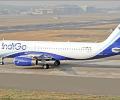
The carriers are scoffing at making the life of their competitors 'easier.
Increases seats in the premium segment, scraps loss-making domestic flights

Budget carrier Go Airlines, which has rebranded itself as 'Go First', has filed preliminary papers for an initial share sale worth Rs 3,600 crore.

To be allotted to other Indian airlines

In little over a year, Air India and IndiGo have announced plans to purchase up to 170 wide-body planes as they bet on ambitious expansion and efforts also continue to make India a global aviation hub. Also, the two carriers' orders usher in European aircraft maker Airbus into the country's wide-body space, which has traditionally been dominated by US major Boeing. If narrow-body aircraft orders of Air India, IndiGo and Akasa Air are added to the list, the order book is well over 1,200 planes and that too in less than 14 months or since February 2023.

One reason is that airlines have ramped up capacity and expanded their presence in tier-II markets. The first of a three-part series analyses how the aviation industry is an outlier in the midst of an overall economic slowdown.
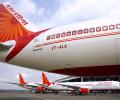
Aviation regulator DGCA on Tuesday said it has imposed a fine of Rs 10 lakh on Air India for denying boarding to passengers holding valid tickets and thereafter not providing the mandatory compensation to them.

'Were the Go First pilots aware that 55 passengers were missing when the aircraft was on ground?'
Domestic air traffic in April this year consisted 10.99 million passengers as compared to 11.51 million passengers in the same month last year, signifying a fall of around 4.5 per cent,

Conforming to the Sharia law, the airline 'strictly prohibits' alcohol in flights and all the food items provided will be 'halal'. Prayers from the Holy Quran will also be recited before the departure of each flight.
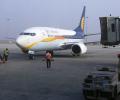
Jet Airways is undergoing insolvency proceedings and at least three entities have put in initial bids for the carrier.

Chief executive officers (CEOs) across sectors have expressed intentions to expand capacities, expecting the government's target to invest a record Rs 11.11 trillion on infrastructure development will act as a catalyst for a jump in consumer demand. "With the government planning a capex of Rs 11.11 trillion, private sector investment will come in a big way. Companies will be preparing for it right from today," H M Bangur, chairman of Shree Cement, told Business Standard. For the past few years, the investment scene in India has been dominated by government capital expenditures; private investments in the manufacturing sector have remained muted.

Industries such as aviation and hospitality have many silos within them and Aionos, the joint venture between Interglobe Enterprises (IGE) and Assago Group, is an attempt to bridge them and boost efficiencies using artificial intelligence (AI) solutions, Rahul Bhatia told Business Standard on Tuesday. Bhatia, the Group Managing Director of IGE, serves as the majority shareholder in India's largest airline, IndiGo. Additionally, IGE operates 21 hotels under the Ibis brand and runs a logistics company called Movin.
As per the current policy, 100 per cent foreign investment is allowed in scheduled air transport service, domestic scheduled passenger airlines and regional air transport

Singapore government's sovereign wealth fund Temasek is looking to invest $10 billion in India during the next three years, Ravi Lambah, Temasek's head of India and strategic initiatives, said.
Sources said the DGCA is reviewing tests by the US-based Federal Aviation Administration (FAA) and European Air Safety Agency (EASA) on mobile phone usage on board aircraft.

The total domestic passengers carried by all scheduled airlines last month was 36.3 lakh (3.63 million) compared with 35.97 lakh (3.59 million) in July, the statistics showed. In July, this figure was lower by about a lakh compared with that in June, indicating stability in the passenger traffic growth rate.
